
Project Trust
Website Rebuild
Project Trust website rebuild by Viewport, resolving Elementor and plugin issues while improving UX, website performance, structure and long-term maintainability.
Client

Skill-set utilised
- Custom website development and WordPress implementation
- Website rebuild and technical restructuring
- Elementor troubleshooting and replacement
- Third-party plugin rationalisation and integration
- User experience optimisation and information architecture
- Responsive website design and front-end development
- SEO-friendly website development
- Conversion-focused calls to action and enquiry journeys
- Flexible content management and page-building functionality
Website URL
Industry
Charity / International Volunteering / Youth Development
Project brief
Rebuilding a Website Affected by Elementor & Third-Party Plugin Issues
Project Trust required a comprehensive website rebuild after its existing WordPress website had become increasingly difficult to manage and maintain.
The previous website had been developed using Elementor alongside a number of third-party plugins. Over time, this created a range of technical and usability issues, with different components and plugins creating dependencies and complications within the website.
Rather than simply applying fixes to an increasingly complex setup, the project provided an opportunity to reassess the website architecture and create a cleaner, more reliable digital platform.
The objective was to deliver a custom website build that would provide Project Trust with a more stable technical foundation while simultaneously improving the user experience.
The rebuild therefore wasn’t simply about creating a new visual design. It involved addressing the underlying problems of the previous website while rethinking how the website worked for its users.
Challenges & Objectives
Moving Away From a Complex Elementor & Plugin Setup
The previous website had accumulated a number of issues associated with its Elementor-based build and multiple third-party plugins.
As websites evolve over time, adding plugins and page-builder functionality can introduce additional layers of complexity. Plugins can interact with one another, updates can create compatibility issues, and page-builder elements can make a website increasingly difficult to maintain consistently.
For Project Trust, these issues had reached the point where continuing to patch and troubleshoot the existing website was no longer the most effective approach.
The decision was therefore made to undertake a complete website rebuild.
The objectives were to:
- Resolve the technical problems associated with the existing website
- Reduce unnecessary reliance on third-party plugins
- Create a cleaner and more maintainable website architecture
- Move away from the limitations and complexity of the existing Elementor implementation
- Improve website stability and reliability
- Create a more consistent content management experience
- Improve the overall user experience
- Simplify navigation and information architecture
- Make volunteering opportunities easier to discover
- Improve the journey from initial research through to enquiry and application
- Create a stronger foundation for future website development
- Establish a more robust SEO-friendly technical structure
The project therefore combined technical website development with extensive user experience optimisation.
Our approach
01
Rebuilding Rather Than Repairing
One of the key decisions was recognising that the existing website had reached a point where simply fixing individual problems would not provide the best long-term solution.
The combination of Elementor and multiple third-party plugins had created technical dependencies and inconsistencies that made ongoing development more complicated.
Rather than continuing to add patches and fixes, I approached the project as a complete website rebuild.
This allowed the underlying structure to be reconsidered and unnecessary complexity to be removed.
The result was a cleaner technical foundation that could be developed and maintained more effectively in the future.
02
Custom Website Build
The new website was developed around the specific requirements of Project Trust rather than continuing to build on the previous collection of Elementor components and third-party plugins.
The custom website build provided greater control over the website’s structure, functionality and user journeys.
This also created a more logical relationship between content, navigation and functionality, making future website development easier to manage.
The goal was not simply to replace Elementor with another visual layer, but to create a website architecture that was appropriate for the organisation’s actual requirements.
03
Reducing Third-Party Plugin Complexity
A major part of the rebuild involved reassessing the functionality that had previously been delivered through multiple third-party plugins.
Third-party plugins can be extremely useful, but an excessive or poorly integrated plugin stack can increase maintenance requirements and introduce compatibility, performance and reliability problems.
The rebuild provided an opportunity to simplify the technology behind the website and avoid unnecessary dependencies.
Where functionality was required, it could be considered as part of the overall website architecture rather than simply adding another plugin.
This created a more controlled and maintainable platform for Project Trust’s ongoing digital requirements.
04
User Experience Optimisation
With the technical foundations being rebuilt, there was also an opportunity to rethink how visitors interacted with the website.
Project Trust has a substantial amount of information covering volunteering opportunities, destinations, applications, fundraising, training, placements, debriefing and its wider community.
The website therefore needed to make this information accessible without overwhelming visitors.
The rebuild focused heavily on UX optimisation, with navigation, page structures, content hierarchy and calls to action designed around the needs of prospective volunteers and other audiences.
The objective was to improve user experience by making it easier for visitors to understand:
- What Project Trust does
- Where they could volunteer
- What the volunteering experience involved
- How the application process worked
- What they needed to do next
- Where to find additional information
05
Content & Information Architecture
The website contains a substantial amount of information covering destinations, placements, fundraising, training, applications, volunteering and the wider Project Trust community.
The rebuild provided an opportunity to reconsider the information architecture rather than simply transferring the existing content into a new design.
Content was structured into clearer sections and user journeys, helping visitors move logically through the information.
This helped turn a large amount of organisational information into a more usable digital experience.
06
Responsive Website Development
The new website was developed to provide a consistent experience across desktop, tablet and mobile devices.
Responsive behaviour was considered throughout the website build, including navigation, page layouts, content blocks, imagery and calls to action.
This ensured that the improved user experience extended across the devices used by prospective volunteers and other visitors.
07
SEO & Digital Foundations
The rebuild also provided an opportunity to establish stronger technical and SEO foundations.
Rather than carrying forward the limitations of the previous website architecture, the new structure was developed with logical page relationships, clearer navigation and search-engine-friendly content structures in mind.
The aim was to create a platform that could support Project Trust’s future organic search visibility while providing a better experience for visitors arriving through search engines.
Key Deliverables
- Complete WordPress website rebuild
- Replacement of the problematic existing website structure
- Reworking of an Elementor-based website
- Reduction of unnecessary third-party plugin dependencies
- Custom website development
- Improved website architecture
- User experience optimisation
- UX optimisation across key user journeys
- Improved information architecture and navigation
- Responsive website development
- Structured content architecture

The Results
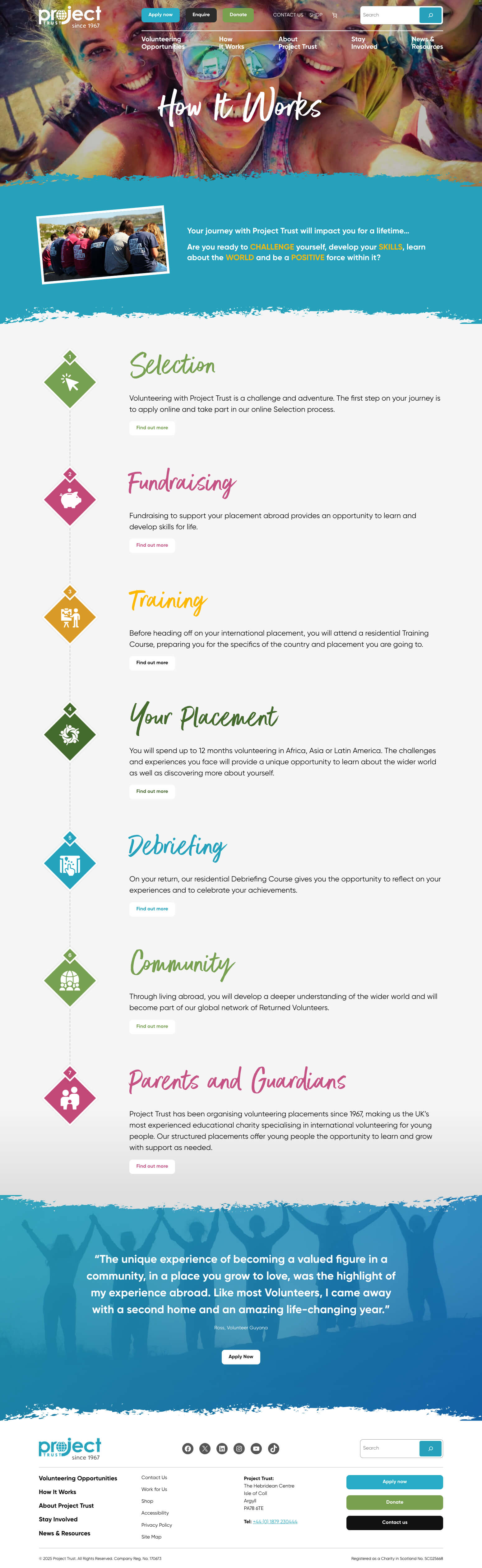
The new Project Trust website provides a cleaner and more reliable digital platform while delivering a significantly improved experience for visitors. Importantly, the project addressed both sides of the problem: the technology behind the website and the experience of using it.
A more maintainable website
The rebuild moved Project Trust away from the complexity of its previous Elementor and multiple-plugin setup, creating a cleaner foundation for future development and maintenance.
Reduced technical complexity
The project provided an opportunity to reassess third-party functionality and reduce unnecessary dependencies, helping create a more controlled website environment.
Improved user experience
The new structure makes it easier for visitors to navigate Project Trust’s extensive information and understand the volunteering journey.
Better content architecture
Information is organised around clearer user journeys rather than simply reflecting the structure of the organisation’s previous website.
Stronger digital foundations
The new website provides a more robust foundation for future functionality, content development, SEO and digital campaigns.
A website designed for long-term development
Rather than continually patching an increasingly complicated website, Project Trust now has a platform that can evolve with the organisation.
The Result
The Project Trust project demonstrates why sometimes a website rebuild is a better solution than continuing to repair an ageing WordPress website. When Elementor issues, plugin conflicts, third-party dependencies and an increasingly complicated website structure begin to affect reliability and ongoing development, continually adding fixes can create more complexity rather than solving the underlying problem.
The solution was to step back, reassess the requirements and create a cleaner custom website build from the ground up. By combining technical website development, UX optimisation and information architecture, the rebuilt Project Trust website provides a stronger foundation for the organisation’s future.
The project demonstrates the value of working with an experienced freelance web builder who can look beyond the visual design of a website and assess the technology, structure, user experience and long-term maintainability as a complete system.